A compliance lint for your code.
Lint your app against the law it answers to. Free.
Claude Code, Codex, or any other coding agent declares what the app does and where it operates. That declaration is the whole input: no source code, schema, or data is uploaded. LexLint returns findings: which obligations apply in each jurisdiction, with citations and freshness dates. It catches the basics early. It is not legal review.
Paste the first line into the agent you already have open. No install, no account, no key.
Install the plugin, or connect any other agentRead the procedure first
Some agents will not fetch a page, or will not act on one they fetched. and paste that instead.
- declared
- generates_content, crawls_web
- operates
 EU,
EU,  Canada, US-California
- law library
EU AI Act, Article 50since Providers of AI systems that interact directly with people must ensure users are informed they are dealing with an AI system unless obvious from context, and providers of generative AI must mark synthetic audio, image, video, or text output in a machine-readable, detectable format.read against its source Canada Uber Technologies Inc. v. Hellersince The joint reasons held that unconscionability requires both an inequality of bargaining power and a resulting improvident bargain.read against its source 3 findings: 2 for code, 1 for counsel
This week in software law
 Hot topic
California’s new laws target workers’ biggest fear of AI taking their jobs
The Guardian
Hot topic
California’s new laws target workers’ biggest fear of AI taking their jobs
The Guardian California
 UK ICO Opens 6-Week Agentic AI Call for Evidence [2026]
shattered.io
UK ICO Opens 6-Week Agentic AI Call for Evidence [2026]
shattered.io United Kingdom
 Ireland: Google fined over EUR 400 million for alleged GDPR infringement in processing users’ location data
Business and Human Rights CentreIreland
Ireland: Google fined over EUR 400 million for alleged GDPR infringement in processing users’ location data
Business and Human Rights CentreIreland
 Swedish regulator fines Miljödata SEK 1.8 million over security shortcomings
PPC Land
Swedish regulator fines Miljödata SEK 1.8 million over security shortcomings
PPC Land Sweden
LexLint sweeps the wire every day across every jurisdiction in the law library, keeps what is about software law, and files each story against a law and a place. All 1,638 stories in the press →
You need LexLint if
- You or your AI agent crawl, train on, or republish other sites' content.
- AI writes any content your users see.
- Your app holds personal data, voices, or faces.
- Under-18s can reach your app, or you check that they can't.
- Your app has users in more than one country.
One checked box is enough. Is the legal risk real?
I build the app.
Run it in the coding CLI you already have open, read the findings in the terminal, and fix the cheap things while the code is fresh. An account keeps every run and turns each finding into a work item.
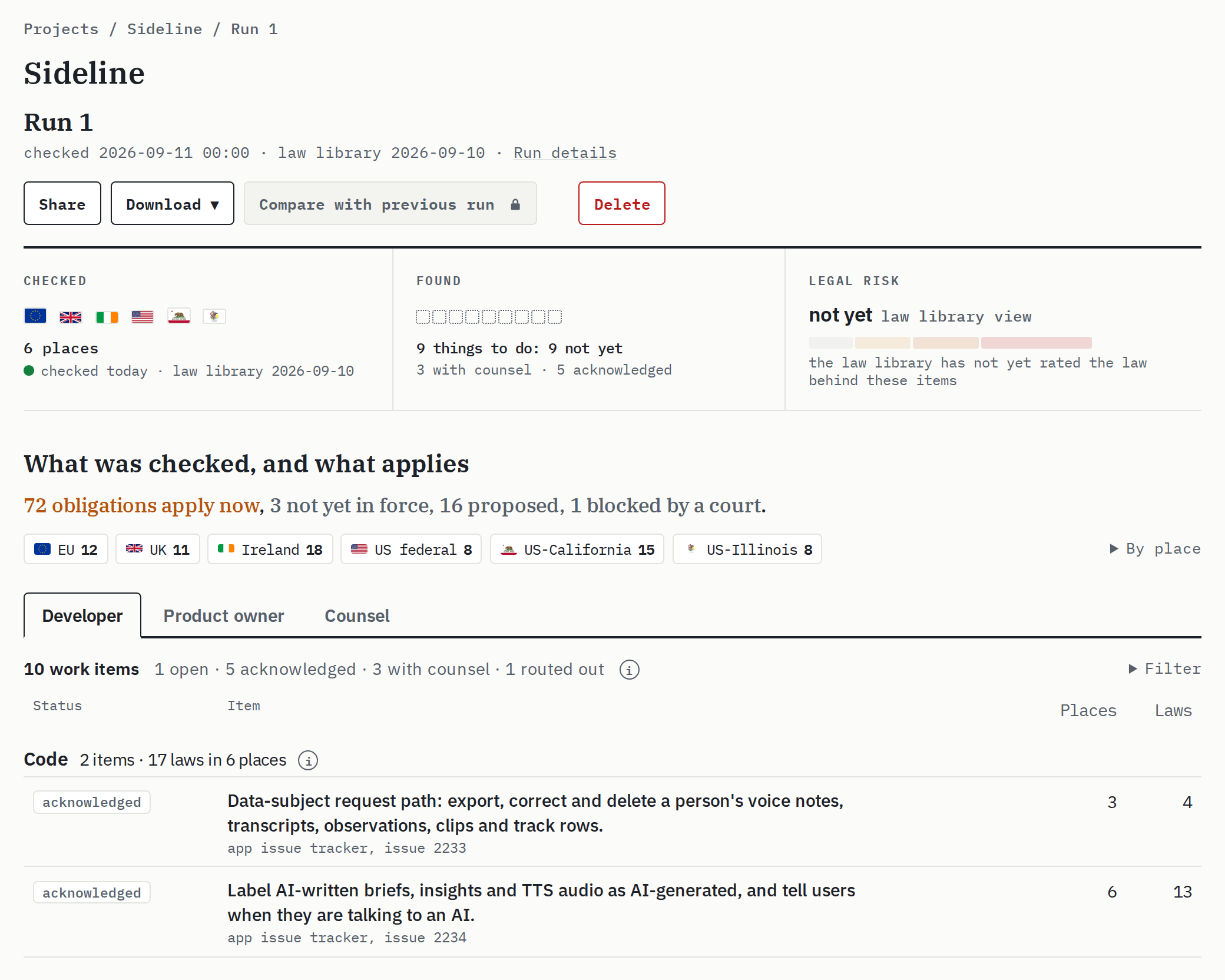
- LexLint for engineersOne run, read four ways
- Install the plugin, or connect any agentClaude Code, Codex, Gemini CLI, Cursor, or any MCP client
- A whole run, start to finish
I advise the company.
What an engineer will hand you, where every citation comes from, and what LexLint will never do.

- LexLint for legal teamsSet it up with your engineers, or read what they send
- The LexLint Legal Handbook Thirteen documents on software law and the law of AI/agents
- The law libraryEvery instrument the lint reads, with its in-force date and when it was last checked
Building it and advising on it? Read the legal page first. It says what the product is for.
The clocks an incident starts
A breach, an exposed person's data, a service down: 254 instruments in 176 jurisdictions set a deadline, each with its own recipient and its own start. LexLint draws every deadline on a single time axis, one flag per clock.
Do you know what to do at each stage of your incident clock?
Sped up. The line is this moment on the drawing; the flags behind it are deadlines already reached.
The law library today
Counted from the law library at each build, across AI, scraping, privacy, cybersecurity, communications, content-moderation, age-gating and reuse law. The law library is rebuilt and republished daily; the research runs in waves, every provision carries the date it was last read against its source. How current is this
- Your code and data are not visible to us.
- The declaration is the whole request. A run reaches the portal only if you choose to upload it. What is sent, and what never is
- The same deal your linter makes.
- Early warning on the basics, cited to the instrument, with a note for counsel where judgment is needed. Nobody mistakes a clean lint for a QA sign-off, and a clean run never says "compliant". What it is, and what it is not
- Built on public law, in the open.
- Every finding cites its source and links the law note behind it where we keep one, and every note says when it was last checked against its source. The law library
Powered by

UnGovr is a nonprofit transparency platform. It builds and runs LexLint, and the LexLint law library is what the lint reads. About UnGovr →
UnGovr is an Associate Member of



The Agentic AI Foundation is the Linux Foundation initiative behind the Model Context Protocol, the standard LexLint speaks. The Open Secure AI Alliance is the Linux Foundation fund on the security of AI agents and the systems they reach. The memberships are UnGovr's own: none of the three reviews, certifies, or endorses LexLint or its findings.
UnGovr is a licensed Supporter of

CIS licenses us to show its Controls' Safeguard numbers beside the laws they bear on. The summaries and the mapping are our own; CIS has not reviewed or endorsed them. The CIS Controls, read against the law →